Agricultural and Extension Education Careers: Turning Research Into Action
Modern agriculture depends on professionals who can turn research into practical education that supports real-world decision-making. For those looking to advance in this work, the MA in Agricultural and Extension Education at NMSU Global Campus provides preparation for leadership in outreach and program development.
Agricultural and extension educators help translate research into practical solutions that address real-world challenges such as:
- Emerging pest threats
- Water scarcity and resource constraints
- Agricultural workforce training and development
- Community and rural development initiatives
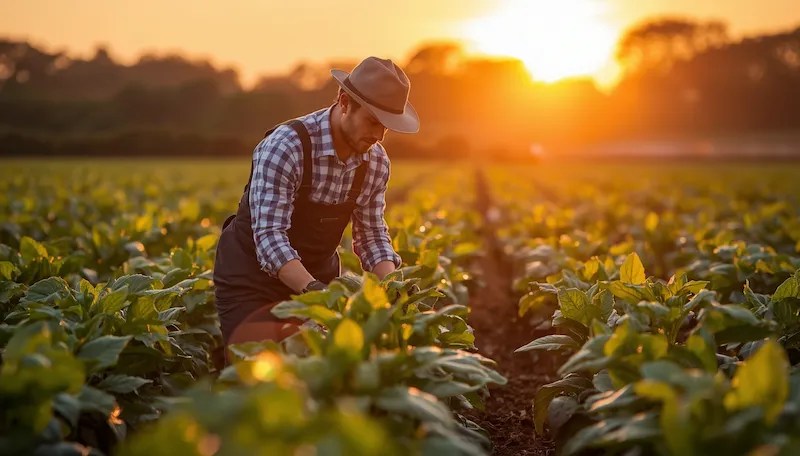
This field focuses on designing and delivering research-based learning for producers, families, youth, and communities connected to agriculture and natural resources. It takes place where real decisions are made: in fields, communities, organizations, and local programs, not just classrooms or laboratories.
Across the United States, agricultural and food-related sectors support more than 22 million jobs and account for about 10.4% of total U.S. employment. 1 The industry also contributes roughly 5.5% of the nation’s gross domestic product (GDP) through production, processing, distribution, retail, and support services. 2
Agriculture touches so many livelihoods and communities. That’s why education and leadership play a critical role in helping people apply research in meaningful, practical ways. This makes agricultural and extension education more important than ever before.
As a land-grant institution with a long extension tradition, New Mexico State University prepares you for this work with an MA in Agricultural and Extension Education. This 100% online degree program is especially valuable for New Mexico public school educators, offering a pathway to advance within secondary education — including the opportunity to pursue Level III teacher licensure.
Explore Your Future in Agriculture With an Online Master’s Degree
Advance Your Teaching Career in New Mexico
If you are currently teaching or considering a move into secondary education, an agricultural extension education degree can support your next step.
This master’s program is designed to help New Mexico teachers qualify for Level III licensure, which opens the door to higher earning potential in middle and high school teaching. Many educators at this level take on leadership roles such as mentoring colleagues, guiding curriculum decisions, or contributing to program development.
Beyond advancing your teacher licensure level, you will build skills you can use every day in the classroom and in your community. You will learn how to design stronger learning experiences, connect agriculture to real-world applications, and better support students as they prepare for careers and life after school.
For educators who want to grow professionally while staying connected to agriculture and serving their communities, this path offers both advancement and purpose.
What Is Agriculture and Extension Education?
Agricultural and extension education is rooted in the U.S. land-grant university system, which was established to expand public access to higher education and applied research. Extension work carries this mission forward by moving university-based knowledge beyond campus and into the communities where decisions are made.
The USDA’s National Institute of Food and Agriculture describes extension as education and learning activities that connect research institutions with farmers, families, youth, and communities. 3 The Cooperative Extension System operationalizes this by ensuring research is translated into practical guidance that can be used in real-world settings.
Rather than existing as a single discipline, extension education functions as a response system to ongoing change. 4 It helps communities interpret and apply research in areas such as:
- Shifts in weather patterns, pest pressures, and environmental conditions that affect production and land management
- Changes in markets, regulations, and industry standards that influence agricultural and organizational decision-making
- Emerging research and applied practices that improve efficiency, sustainability, and community outcomes
In practice, this work is shaped by local context. Solutions are adapted to the realities of specific communities, operations, and resources rather than applied as universal models.
What Agricultural and Extension Educators Do
Extension professionals connect university-based research with the everyday decisions that shape agriculture, education, and community life. Their work responds to local needs across land management, production, youth development, and organizational programs. They translate complex information into practical guidance people can actually use.
In practice, agricultural and extension education work often includes:
- Designing and delivering educational programs through workshops, field demonstrations, trainings, online resources, and community-based initiatives
- Translating research and technical findings into clear recommendations, hands-on demonstrations, and decision-support tools
- Working directly with producers, local agencies, community organizations, and industry partners to address region-specific challenges
- Supporting youth development programs, workforce training, and local leadership or capacity-building efforts
- Evaluating program outcomes to improve effectiveness, strengthen engagement, and demonstrate measurable impact
Ag extension work goes beyond sharing information. It involves shaping how knowledge is understood and used in real-world contexts. You’ll help individuals and communities make informed decisions, strengthen capabilities, and improve long-term outcomes.
Explore Online Graduate Degrees in Agriculture from
New Mexico State University
Interested in how agricultural information is communicated across media, organizations, and public audiences? NMSU Global Campus also offers an MA concentration in Agricultural Strategic Communication. Explore these agricultural master’s degrees with 100% online coursework:
Explore Career Paths in Agricultural and Extension Education
A master’s degree in agricultural and extension education prepares you for roles that combine education, outreach, and leadership. Graduates often move into positions that go beyond technical expertise, focusing instead on developing programs, engaging diverse audiences, and supporting the practical application of knowledge in local communities.
While many NMSU grads pursue or continue careers in education, including secondary teaching roles in New Mexico, a master’s degree in agricultural and extension education can also open doors to a broader range of outreach, program leadership, and community-based positions.
Explore this list of several common career paths. Keep in mind that earnings may vary by employer type, region, and scope of responsibility.
Extension Educator or Extension Agent
Extension educators deliver research-based education through workshops, consultations, field demonstrations, and online programming. Many specialize in areas such as agriculture, natural resources, youth development, or community education. Strong listening and communication skills are essential for translating research into guidance people can use. Median annual earnings often align with community education and outreach roles, exceeding $60,000 per year in some work settings. 5
Agricultural Education Specialist
Agricultural education specialists focus on the design side of education. They develop curriculum, support instructor training, help align learning outcomes with industry needs, and build education resources used across a district, state, or organization. This path may be a great fit for educators who enjoy building learning systems that can scale beyond a single event or workshop. The national median annual wage for those working in this role is about $44,000. 6
Program Coordinator or Outreach Manager
Program coordinators and outreach managers keep education initiatives moving, from planning through evaluation. They manage partnerships, coordinate logistics, track outcomes, support budgets, and report impact to stakeholders or funders. These roles are common across universities, extension services, nonprofits, government agencies, and industry organizations. For a national benchmark tied to program leadership and coordination, you can expect annual earnings of around $70,000. 7
Community Development Professional
Community development professionals support economic development, workforce readiness, and community resilience at the local or regional level. In agricultural settings, this work often includes food systems planning, rural development initiatives, youth engagement, or resource education.
Agricultural and extension education prepares professionals for these roles by emphasizing facilitation, collaboration, and applied learning. Community development work relies on listening, adaptability, and the ability to guide groups through problem-solving rather than applying one-size-fits-all solutions.
Training or Workforce Development Specialist
Training and workforce development specialists design and deliver education that helps people build job-ready skills. In agriculture and natural resources, this may include safety training, technical instruction, leadership development, or onboarding programs.
These roles are common across agribusinesses, cooperatives, government agencies, and nonprofit organizations. A master’s degree in agricultural and extension education supports this work by combining industry knowledge with adult learning design and program evaluation skills.
Is a Master’s in Agricultural and Extension Education Right for You?
Many professionals enter extension education because they enjoy hands-on work and problem-solving. Over time, roles often expand to include training others, leading programs, coordinating outreach, or representing organizations in the community.
A master’s degree in agricultural and extension education, such as the Master of Arts in Agricultural and Extension Education at NMSU Global Campus, supports that shift. Instead of relying on trial and error, you’ll build skills in adult education, program design, communication, leadership, and evaluation. These skills help you move from doing the work to teaching it, scaling it, and improving it over time.
Graduate education will also help you:
- Step into roles that involve teaching and leadership.
- Build credibility in education and outreach settings.
- Develop skills you can use in many settings.
- Learn how to show impact, not just activity.
For professionals who care about service, learning and long-term community outcomes, this field offers work that is both practical and meaningful. It is a path for people who want to strengthen agriculture by improving the way knowledge is shared, understood and used.
Earn Your Agricultural and Extension Education Degree Online at NMSU Global Campus
This online MA program is built for working professionals to stay in your current role while developing skills you can apply directly to your work in education, outreach, and community programs.
For New Mexico teachers, it also offers a clear path toward Level III licensure, supporting career advancement while increasing earning potential and leadership opportunities within secondary education.
Grounded in a strong land-grant tradition, the program emphasizes practical, real-world learning and prepares you to lead education and outreach efforts with confidence. You will focus on:
- Applied learning grounded in real-world contexts
- Community engagement and outreach leadership
- Flexible online delivery for working professionals
- Preparation to translate research into practical action
Explore the online MA in Agricultural and Extension Education program at NMSU Global Campus to build the skills for agricultural education, extension, and community outreach careers.
References
1. Kassel, K. “Agriculture and its related industries provide 10.4 percent of U.S. employment.” U.S. Department of Agriculture (USDA), 3 November 2023.
2. Martin, A. “Ag and Food Sectors and the Economy.” U.S. Department of Agriculture, 8 January 2025.
3. “What We Do: Extension.” U.S. Department of Agriculture, accessed 14 April 2026.
4. “What is Extension? What is Land Grant University?” New Mexico State University, accessed 14 April 2026.
5. “Extension Educator Average Base Salary.” Salary Expert Powered by ERI, 6 January 2026.
6. “Agricultural Education Salary.” ZipRecruiter, accessed 14 April 2026.
7. “Program Coordinator yearly salaries in the United States for U.S. Department of Agriculture.” Indeed, accessed 14 April 2026.
About New Mexico State University Global Campus
At NMSU Global Campus, our mission is to help prepare the next generation of leaders. We focus on offering high-quality education that spans a multitude of disciplines and career pathways. Whether you’re seeking a degree or certification in teaching, science, engineering, healthcare, business, or others, we provide exciting opportunities that can help shape your future.
New Mexico State University is accredited by the Higher Learning Commission, an institutional accreditation agency recognized by the U.S. Department of Education. Specialized accreditation from other accrediting agencies is also granted for some programs. We offer flexible, career-focused 100% online courses and degree options in New Mexico, across the nation, and around the globe. Start your journey with our accessible and affordable degree options.
Get Your Personalized Program Info
Recent Agriculture and Consumer Sciences Posts

Food Science and Public Health: Connecting Nutrition, Safety and Technology
Safe, nutritious, high-quality food depends on professionals who know the science behind every step of the process. An online Master...
Read More about Food Science and Public Health: Connecting Nutrition, Safety and Technology
Can a Master’s in Animal Science Help You Prepare for Veterinary School?
Preparing for veterinary school requires more than just meeting prerequisites. For students looking to strengthen their profile before applying to...
Read More about Can a Master’s in Animal Science Help You Prepare for Veterinary School?
Emerging Careers Shaping the Future of Food Science and Technology
The next big shift in food science and technology doesn’t always start in a boardroom. Sometimes it starts with a...
Read More about Emerging Careers Shaping the Future of Food Science and Technology