Community College vs. University: What’s the Difference?
Should you go to community college or a 4-year university? Compare the costs, degree options, and benefits of each to find the right path for you. Plus, explore how 100% online bachelor’s degree programs at NMSU Global Campus can help you reach your educational and career goals.
If you’re weighing an associate degree vs. a bachelor’s degree, it’s worth looking at what each has to offer. Both can lead to valuable credentials, new career opportunities, and higher earnings.
According to 2025 data from the U.S. Bureau of Labor Statistics, workers with associate degrees earned an estimated $8,800 more annually than those with only a high school diploma. 1 Bachelor’s degree-holders also earned 39% more per week than associate degree-holders. 2
Whether you’re finishing high school, returning to college, or becoming the first in your family to pursue higher education, this guide compares community colleges and universities side by side. You’ll explore costs, admission requirements, time to graduation, student support, and learning options. We’ll also look at when it makes sense to transfer or start a bachelor’s program right away.
What Is the Difference Between Community College and University?
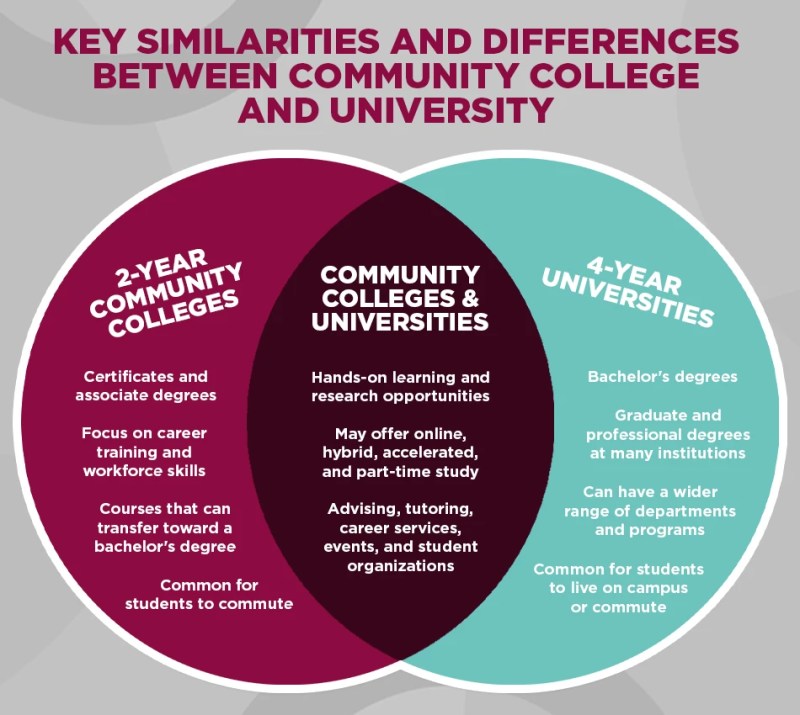
One of the biggest differences between community colleges and universities is the types of degrees they offer. Community colleges typically focus on certificates, associate degrees, and career training, while universities offer bachelor’s degrees and opportunities for advanced study.
But you don’t necessarily have to choose one over the other. Many community colleges work with universities to help students transfer credits toward a bachelor’s degree. This means you can begin your education at a community college and continue at a university when you’re ready.
Similarities Between Community Colleges and Universities
Community colleges and universities have more in common than you might expect. Both offer opportunities to build new skills, prepare for careers, and connect with instructors and classmates.
Both types of institutions may also offer flexible learning options, including online and hybrid programs, part-time schedules, evening classes, and accelerated terms. Student resources such as academic advising, tutoring, financial aid guidance, and career services can help you balance college with work, family, or other responsibilities.
But how do you decide which path is right for you? Let’s compare the key differences between community colleges and universities.
Community College vs. University: Side-by-Side Comparison
Before exploring each difference in more detail, compare community colleges and universities side by side. Consider which factors matter most to you, including tuition costs, admission requirements, degree options, and learning flexibility.
| Key Differences | 2-Year Community College | 4-Year University |
|---|---|---|
| Cost and Financial Aid | In-district tuition is often lower, and students may have access to scholarships, grants, and other financial aid. | Public universities may offer affordable in-state tuition, along with grants, scholarships, and other aid. |
| How Long It Takes | You can complete a certificate or associate degree in about two years full-time. | A bachelor’s degree generally takes about four years of full-time study. |
| Admission Requirements | Many community colleges have open or broad admission policies, though some programs may have additional requirements. | Admission requirements vary by university and program. They may include application materials, academic requirements, and other criteria. |
| Student Support | Advising, tutoring, career services, and transfer guidance may help you complete a credential or prepare for further study. | Universities may offer advising, tutoring, career development, academic departments, and specialized student services. |
| Learning Options | Depending on the program, you may find in-person, online, hybrid, evening, and part-time classes. | Universities may offer the same mix of online, in-person, hybrid, full-time, and part-time options. |
| Campus Life | Community colleges often serve local and commuting students. Many have options for clubs, events, and campus activities. | Many universities offer residence halls, athletics, student organizations, research, alumni networks, events, and campus activities. |
| Career Paths | Certificates and associate degrees can prepare you for many careers. Transferable courses can also count toward a bachelor’s degree. | Bachelor’s degrees can prepare you for careers that require a four-year degree and can be a step toward graduate or professional education. |
Now that you’ve seen how community colleges and universities compare, let’s take a closer look at the factors that may influence your decision, including costs, admission requirements, and learning options.
Cost and Financial Aid at Community Colleges and Universities
Cost is one of the biggest factors for students comparing their options for college. But tuition is only part of the picture. Financial aid like scholarships and grants can lower your costs. Other expenses, including books, a laptop, course fees, housing, and transportation, can all add to what you’ll actually pay.
- Most community colleges charge less in tuition and fees than four-year colleges, especially for students who qualify for in-district or in-state rates. In-district students pay an average of $4,150 in tuition and fees at public two-year colleges. 3 Community college students may also qualify for federal and state aid, school scholarships, and programs that cover tuition for eligible students.
- Most universities also offer financial aid to help cover college costs. Public universities can be much more affordable for in-state students than private colleges or out-of-state public universities. In fact, average published in-state tuition and fees at public universities are about 73% lower than at private four-year nonprofit institutions. 4
When weighing community college vs. university costs, compare what you’d actually pay after grants and scholarships, along with books, fees, housing, and transportation. Before you rule out a school based on its published tuition, talk with its financial aid office. Staff can explain the Free Application for Federal Student Aid (FAFSA), help you understand which grants and scholarships you may qualify for, and point you toward school-specific funding. 5
Some states also have programs that help eligible residents cover tuition at public colleges and universities. The New Mexico Opportunity Scholarship may cover up to 100% of tuition. 6 It’s available to eligible residents of any age who want to earn, or return and complete, their first undergraduate degree.
Affordable Online Tuition and Financial Aid at NMSU Global Campus
NMSU Global Campus offers a flat undergraduate tuition rate of $395.40 per credit, regardless of where you live or how many courses you take.
Enrolling in four classes, or 12 credits, costs about $4,745 each semester before fees. And if you’re an eligible New Mexico resident, the New Mexico Opportunity Scholarship may cover up to 100% of tuition and required fees for your first bachelor’s degree. Federal and state aid and NMSU scholarships through ScholarDollar$ may offer other ways to save you money.
Find Your Place at NMSU
If you’re considering NMSU Global Campus, we’ll help you explore online programs.
Connect with us today!
How Long It Takes to Earn an Associate vs. a Bachelor’s Degree
Although associate and bachelor’s degrees are often described as two-year and four-year degrees, those timelines aren’t guaranteed.
Your major, any transfer credits, and whether you attend full- or part-time can affect how long it takes you to graduate.
- An associate degree requires about 60 credits and can often be completed in about two years of full-time study.
- A bachelor’s degree requires about 120 credits and typically takes about four years of full-time study.
A full-time college schedule often means taking about 12 to 15 credits per semester, or roughly four to five typical three-credit classes. A part-time student might take one or two classes per term instead. That can make college easier to balance with work or family, but it usually takes longer to finish. It can also take longer if you change majors or take courses that don’t apply to your degree requirements.
As you compare schools, consider how much time you can devote to classes and how quickly you want to earn your degree. Check whether each school offers part-time study, summer courses, or accelerated terms that fit your schedule.
NMSU’s online bachelor’s degrees can fit different schedules and starting points. Many programs offer eight-week courses, and you can study part-time or take on a heavier course load when life allows. You may also be able to transfer up to 90 credits toward a bachelor’s degree, or about 75% of a 120-credit program. A free unofficial credit evaluation can help you understand how your credits could transfer.
Related: Take a closer look at the pros and cons of part-time vs. full-time college in the NMSU Global Campus blog. 7
Admission Requirements at Universities vs. Community Colleges
Admission requirements can differ significantly between community colleges and universities. Many community colleges have open admission policies, while universities typically establish their own admission standards. However, attending a university doesn’t necessarily mean facing a competitive admissions process. Requirements vary by institution, degree program, and student type.
- Many community colleges have open or broad admission policies, which means students who meet basic requirements can usually begin taking classes. Some programs, such as nursing, might have additional prerequisites or competitive admission.
- Most universities establish their own admission standards. They may consider grades, test scores, essays, and other application materials. Some have more accessible admission policies while others are very competitive. Individual programs may have additional requirements.
Some community colleges and universities have transfer agreements that outline how credits or specific associate degrees apply toward a bachelor’s degree. These agreements can help you choose courses that count toward your next program and establish a clearer transfer pathway.
If you don’t yet meet the admission requirements for your preferred university or degree program, community college may give you another way to work toward that goal. You can complete college-level courses, build your academic record, and potentially earn an associate degree while preparing to transfer.
Admissions and Transfer Options at NMSU Global Campus
Admission at NMSU Global Campus starts with a free online application and clear admission requirements. Bachelor’s programs offer rolling admissions year-round, so you can apply when you’re ready and plan for an upcoming eight-week term.
Undergraduate applicants are asked to have at least a 2.5 GPA for regular admission, and transfer students qualify with a 2.0 GPA. Get in touch with an admissions advisor if you want help understanding your options and next steps!
Explore transfer pathways from Central New Mexico (CNM) Community College to NMSU Global Campus and see how you can earn your bachelor’s degree online.
Support for Community College and University Students
The amount and type of support you receive can vary more by institution and program than by whether a school is a community college or university. You might prefer smaller classes and regular access to your instructors, or you might value a wider range of majors, facilities, and research opportunities. For a first-generation college student, knowing where to find advising and financial aid guidance can make college easier to navigate. Look beyond the type of institution and ask about the student support services that matter most to you.
- Community colleges may focus on helping you complete a certificate or associate degree, prepare for a career, or plan your transfer to a university. Depending on the school, you may have access to tutoring, academic advisors, career services, and instructors who work closely with students.
- Universities may offer academic advising, tutoring, writing support, career counseling, libraries, research resources, and services for specific student groups. You also have access to faculty with expertise in your field and opportunities to connect coursework with internships or research.
Think about which resources would make college easier to navigate for you. If personal attention matters, ask about class sizes and how students connect with their instructors outside class. Or you might prioritize academic advising, career planning, or online tutoring.
At NMSU Global Campus, online students have access to a dedicated, personalized Graduation Team for help with academic planning, financial aid, career questions, and staying on track toward graduation. Free student resources include one-on-one tutoring and writing assistance. Students can also access virtual medical and mental health support through TimelyCare, available 24/7.
Build your math confidence. Prepare for college-level courses with the free online College Math Readiness program from NMSU.
Learning Options: Online, In-Person, and Hybrid Classes
Your college experience doesn’t have to follow a traditional schedule. You might attend classes on campus during the week, take evening courses, or complete online coursework on weekends.
- Community colleges may offer in-person, online, hybrid, evening, and part-time courses. Some career programs also include labs, clinical experiences, or other hands-on requirements that need to happen in person.
- Universities may offer these same in-person, online, hybrid, evening, and part-time learning options. And they may also have internships, research, labs, and other hands-on opportunities. You may be required to complete some activities in person, even if you take most of your classes online.
What commitments do you need to work around? How many classes can you realistically take? Would online courses make it easier to manage your schedule? Consider your career goals, too. Your field of study may require some in-person training.
Online classes at NMSU Global Campus give you options for fitting college into your week. Many courses are asynchronous, so you can complete coursework around other responsibilities rather than attending at a set time. Eight-week mini-semesters that run year-round give you additional scheduling flexibility. 8 You can access your coursework from a computer, laptop, or phone wherever you have internet access. Technical support is available to help, too.
Related: Take a closer look at how online classes work in the NMSU Global Campus blog. 9
Community College vs. University Campus Life
College is a chance to meet people who share your interests, learn from people with different experiences, and build relationships with instructors and mentors. You may also make connections that help you explore careers and find opportunities after graduation. Even as a community college or an online student, you can build relationships without living on campus.
- Community college campuses often serve students who live nearby, including recent high school graduates, working adults, parents, and students preparing to transfer. Many students commute, but campuses may still offer student clubs, events, athletics, research opportunities, and spaces to study or connect with classmates.
- University campuses may offer a broader range of campus activities, with more students living on campus during the school year. Depending on the school, you may find student organizations, athletics, cultural events, research opportunities, and activities tied to your major.
Think about whether you want to live on campus, commute, or study online. Consider how much time you want to spend on campus, which activities interest you, and whether you prefer a close-knit community or a larger campus with more opportunities to explore.
Online students at NMSU Global Campus are part of New Mexico State University, not a separate online-only school. You can connect with university resources, explore student organizations, and take part in available campus and virtual activities. NMSU’s recognition as a Land Grant, Hispanic-Serving, and First-Generation Recognized Institution and Military Friendly® School reflects its commitment to serving students with diverse goals. Your classes may be online, but you’ll still be part of the Aggie community.
Associate vs. Bachelor’s Degrees: Fields of Study and Career Paths
Whether you should go to community college first depends partly on the qualifications your target career requires. An associate degree may be enough to get started in some fields, while others require a bachelor’s degree or graduate study. Exploring the qualifications for jobs that interest you can help you choose where to begin.
- Associate degree career paths span a huge range of industries. Liberal arts and general studies are the most common fields for associate degrees, followed by health and business. 10 Many students also earn degrees in areas such as engineering technology, computer science, and public safety.
- Bachelor’s degree career paths are also wide-ranging and diverse. Business is the most common field for bachelor’s degrees, followed by health professions. 11 Social sciences, biology, psychology, and engineering are also popular choices.
Start with some of the careers that interest you, then work backward. If you can enter your target field with an associate degree, community college may be your ticket. If the career requires a bachelor’s or graduate school, you have options. You could go straight to a 4-year university or start at a community college and transfer later.
Explore 90+ online programs at NMSU Global Campus to help you prepare for a new career or build on the experience you already have. Our Career Services coordinators are also available to assist with career planning, resumes, job interviews, and professional development. Virtual career fairs and Handshake can help you explore opportunities and connect with employers. Some programs also include internships or field placements arranged in your local community, so you can apply what you’ve learned.
Should You Go to Community College First, or Straight to a Bachelor’s?
There’s no single right way to earn a degree. If you’re wondering whether you should go to community college first or enroll directly at a university, start by considering your career goals, budget, and how much time you can devote to school. Use these questions to help determine which path is right for you.
- What career interests me? Look up a few jobs you’d like to pursue. What degree, training, or license do they require?
- What can I afford? Compare tuition, fees, financial aid, and other costs at the schools you’re considering. Consider any transportation or housing costs, too.
- How much time can I give school? Think about your work schedule, responsibilities, and how many classes you can take. Ask about part-time options and online courses if you need flexibility.
- What are the admissions requirements? Check what each school requires to apply. If you’re worried about qualifying, ask an admissions advisor about your options.
- What support will I have? Find out whether each school offers the services you’ll use most, like academic advising, tutoring, financial aid guidance, tech support, and career services.
- What do I want my college experience to look like? Consider whether you want to live on or off campus. Do you plan on joining student organizations and attending a lot of events? Would you prefer to connect with classmates online?
If you’re still not sure, ask the experts. Contact the admissions or academic advising offices at the schools you’re considering and explain what you’re hoping to do. Ask them to walk you through your options, costs, and next steps before you decide.
Pros of Transferring to University from a Community College
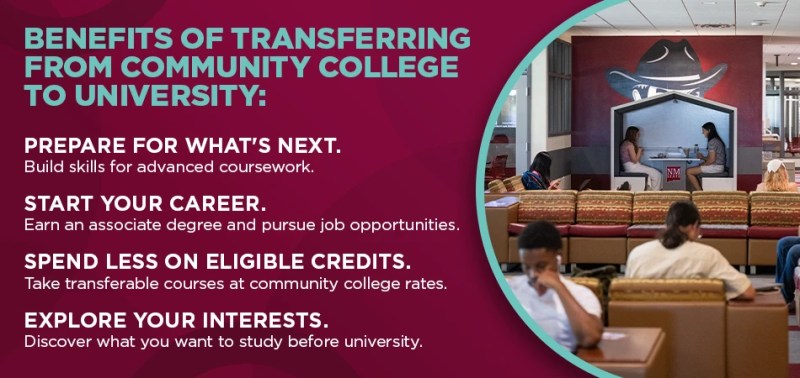
If you’re working toward a bachelor’s degree, starting at a community college may be a practical way to begin. Planning ahead with your intended university can help you choose courses that count toward your degree and avoid unnecessary costs or delays after you transfer.
Transfer requirements vary by school and major, so it’s important to confirm which credits will count before enrolling. With the right plan, community college can be one step toward a bachelor’s degree.
Find clear tips on transferring your college credits to an online program in the NMSU Global Campus Blog. 12
FAQ: Community College vs. University
Whether you’re thinking about earning an associate degree, transferring to a university, or pursuing a bachelor’s degree from the start, you probably have a few questions. Let’s answer some of the most common ones.
What are the key differences between universities and community colleges?
Community colleges typically offer certificates and associate degrees, while universities offer bachelor’s degrees and often graduate degrees, too. Both can prepare you for a career, and many community colleges offer courses you can transfer toward a bachelor’s degree.
What are the pros and cons of community college vs. university?
Community college may help you manage education costs, explore career interests before committing to a bachelor’s degree, or earn a credential you can use to enter the workforce sooner. Starting at a university allows you to pursue a bachelor’s degree from the beginning, with opportunities to develop relationships with faculty and classmates throughout your studies.
You may also have a wider range of academic areas to study and more opportunities to pursue internships or research related to your major.
The potential drawbacks depend on your needs. Consider cost, flexibility, admissions requirements, academic support, and whether the school offers the learning experience and career preparation you need.
Is community college better than university?
Neither is automatically better. What might work best for you could come down to what you want to study, what you can afford, and how you want college to fit into your life. Both community colleges and universities can offer strong academics, flexibility, career preparation, and supportive instructors. Focus on finding a school and program for your goals rather than choosing by school label alone.
Is community college a good way to save money on a four-year degree?
It can be, especially if you complete transferable courses at a community college with lower tuition before moving to a university. Your savings depend on tuition, financial aid, and whether your credits apply to your bachelor’s degree requirements. You may save less if credits don’t transfer or don’t count toward your major. Make sure you work closely with your academic advisor when choosing classes.
Do employers view community college degrees differently than university degrees?
Employers value the education and skills that match the job, and many careers specifically require or accept certificates and associate degrees. Other positions require a bachelor’s degree or higher, so check the qualifications for the roles you want.
Find Your Online Bachelor’s Degree at NMSU Global Campus
Prepare for your next career move with a 100% online bachelor’s degree and resources to support your success. NMSU Global Campus offers career-focused online programs alongside services like tutoring, mentorship, and online career fairs. You can learn closely from New Mexico State University faculty, connect with a global learning community, and build skills relevant to your career goals, even while you balance your other life responsibilities.
Already earned college credits? NMSU Global Campus allows eligible undergraduate students to transfer up to 90 credits toward a bachelor’s degree. You can check how close you are to a bachelor’s degree with a free unofficial transcript evaluation.
Explore NMSU’s 100% online bachelor’s programs or connect with our admissions team for guidance on choosing a degree and planning your next steps.
References
1. “Education pays, 2025.” Career Outlook, U.S. Bureau of Labor Statistics, September 2026.
2. “Education Pays: Unemployment Rates and Earnings by Educational Attainment, 2025.” U.S. Bureau of Labor Statistics, updated 1 September, 2026.
3. “Trends in College Pricing: Highlights.” College Board Research, accessed 16 October 2026.
4. “Trends in College Pricing: Highlights.” College Board Research, accessed 16 October 2026.
5. “Your 2027 Guide to Completing the FAFSA Form.” NMSU Global Campus Blog, 1 September 2026.
6. “New Mexico Opportunity Scholarship.” New Mexico State University Global Campus, accessed 16 October 2026.
7. “Full-Time vs. Part-Time Online College Degrees: Pros and Cons.” NMSU Global Campus Blog, 25 August 2026.
8. “8-Week Online Courses: 3 Career-Boosting Reasons to Choose NMSU Global Campus.” NMSU Global Campus Blog, 20 August 2026.
9. “How Do Online Classes Work? A Guide to Online Learning at NMSU Global Campus.” NMSU Global Campus Blog, 5 May 2026.
10. “Undergraduate Degree Fields.” National Center for Education Statistics, last updated May 2024.
11. “Undergraduate Degree Fields.” National Center for Education Statistics, last updated May 2024.
12. “A Clear Path to Transfer Your College Credits to an Online Program.” NMSU Global Campus Blog, 8 December 2025.
About New Mexico State University Global Campus
At NMSU Global Campus, our mission is to help prepare the next generation of leaders. We focus on offering high-quality education that spans a multitude of disciplines and career pathways. Whether you’re seeking a degree or certification in teaching, science, engineering, healthcare, business, or others, we provide exciting opportunities that can help shape your future.
New Mexico State University is accredited by the Higher Learning Commission, an institutional accreditation agency recognized by the U.S. Department of Education. Specialized accreditation from other accrediting agencies is also granted for some programs. We offer flexible, career-focused 100% online courses and degree options in New Mexico, across the nation, and around the globe. Start your journey with our accessible and affordable degree options.
Related Resources
Get Your Personalized Program Info
Recent General Posts

Careers for Bilingual Spanish Speakers: 15 Jobs Where Spanish Is a Professional Advantage
Knowing both Spanish and English is a valuable skill you can bring to many workplaces. From business to technology jobs,...
Read More about Careers for Bilingual Spanish Speakers: 15 Jobs Where Spanish Is a Professional Advantage
Your 2027 Guide to Completing the FAFSA Form | NMSU Global Campus
Navigating the college financial aid landscape can feel like traversing a maze with no clear exit. For students at New...
Read More about Your 2027 Guide to Completing the FAFSA Form | NMSU Global Campus
Finish Your Degree: How to Affordably Complete Your Bachelor’s Online
You don’t need to put your life on hold or break the bank to graduate with a quality college education....
Read More about Finish Your Degree: How to Affordably Complete Your Bachelor’s Online